
There are certain periods in history that have irrevocably changed the trajectory of the human race. The Renaissance transformed knowledge. The Industrial Revolution transformed production. World War II accelerated technological innovation on a scale never before seen. Today, we find ourselves at the beginning of another transformative era: the Age of Artificial Intelligence.
Artificial intelligence is rapidly changing how we communicate, analyze information, and perform work. Some of the most significant changes are occurring in the workplace, where employers are increasingly turning to AI-driven tools to improve efficiency and productivity. In Human Resources, professionals are being encouraged to use artificial intelligence for everything from recruitment and candidate screening to policy development, employee communications, and training creation.
Yet amid the excitement surrounding this new technology, an important question often goes unasked:
Are we still in compliance with state and federal employment laws?
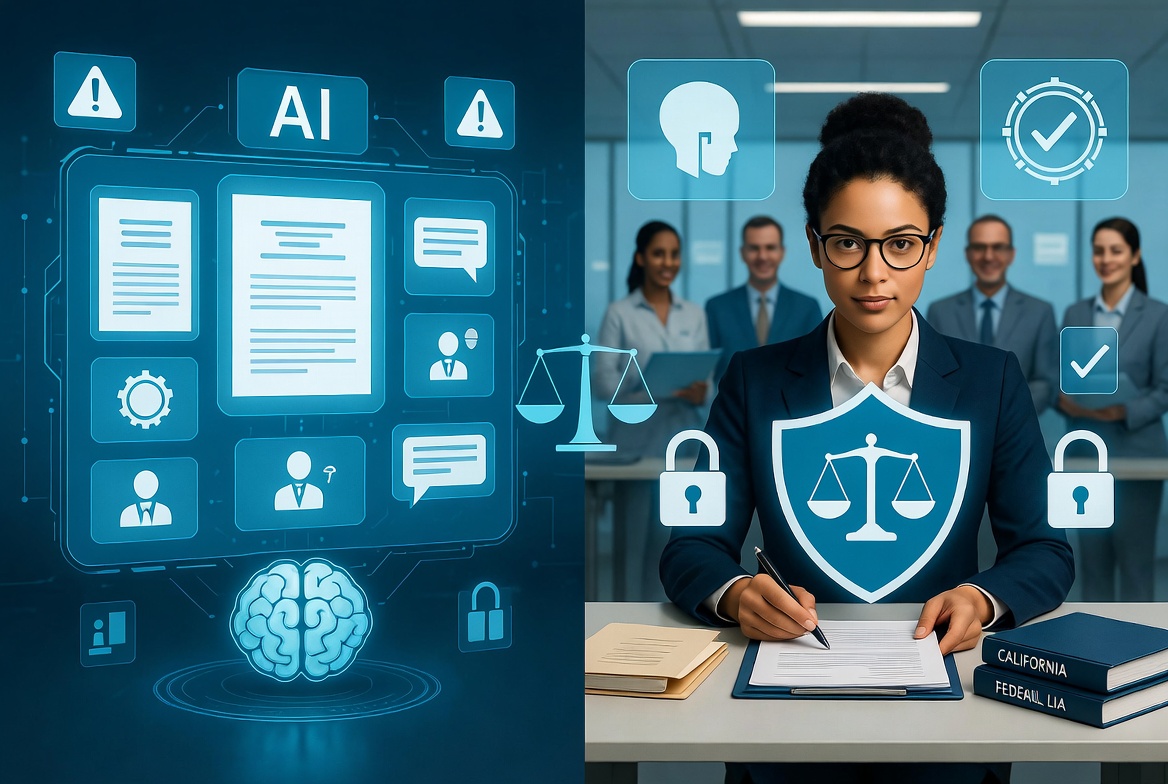
While AI is an excellent productivity tool, HR professionals must understand that using artificial intelligence does not eliminate their compliance obligations. Federal and California employment laws still apply, and employers remain responsible for decisions influenced by AI. As organizations rush to embrace innovation, Human Resources professionals must ensure that efficiency never comes at the expense of compliance.
Consider an employer that uses an AI screening tool to rank job applicants. If the system disproportionately excludes applicants based on age, disability, race, or another protected characteristic, the employer may still face liability even if the decision was generated by software rather than a human reviewer.
The Benefits of AI in Human Resources
When used appropriately, AI can significantly reduce administrative burdens and allow HR professionals to focus on higher-value work.[1]
Common applications include:
- Drafting job descriptions and recruitment advertisements
- Developing interview questions
- Creating employee communications
- Generating training materials and quizzes
- Assisting with policy development
- Organizing investigation notes
- Creating checklists and compliance tools
- Translating workplace documents
These applications can save hours of manual work and increase consistency across HR functions. For small businesses without a dedicated HR department, AI can help bridge knowledge gaps and improve access to information.
However, efficiency should never be confused with accuracy or legal compliance.
Federal Agencies Are Paying Attention
Although there is currently no comprehensive federal law regulating AI in employment decisions, federal agencies have made their position clear: existing employment laws apply regardless of whether decisions are made by humans or assisted by technology.
The Equal Employment Opportunity Commission (EEOC) has repeatedly warned employers that the use of AI in hiring, promotion, performance management, and other employment decisions may violate federal anti-discrimination laws if technology creates discriminatory outcomes.[2]
Similarly, the U.S. Department of Labor has emphasized the importance of human oversight, transparency, accessibility, and accommodation when AI tools are used in employment practices.[3]
The message from federal regulators is straightforward. Employers cannot avoid liability by blaming the software.
California’s Approach to Artificial Intelligence
California has emerged as one of the nation’s leaders in regulating the use of artificial intelligence in employment decisions. Recent regulations adopted by the California Civil Rights Council clarify that California’s anti-discrimination laws apply to automated decision systems used in employment settings. These regulations address the use of artificial intelligence and algorithmic tools in areas such as recruiting, hiring, promotion, compensation, performance evaluations, and termination decisions.
For California employers, the implication is significant. The fact that a decision was generated or influenced by artificial intelligence does not shield the employer from legal responsibility.[4]
If an AI-driven process disproportionately impacts a protected group, regulators will examine the employer’s practices, not just the software vendor’s technology.
The Four Biggest Compliance Risks
1. Discrimination and Adverse Impact
AI systems are trained using data. If that data contains historical bias, the resulting recommendations may also reflect that bias.
Employers should be particularly cautious when using AI tools to screen applicants, rank candidates, evaluate employees, or recommend employment actions.
Regular audits and human review remain critical safeguards.
2. Privacy and Confidentiality
HR departments routinely handle sensitive information, including medical records, accommodation requests, investigation files, and personnel data.
Before entering information into an AI platform, employers should understand how the information is stored, used, and protected. Uploading confidential employee information into public AI systems may create privacy concerns and increase organizational risk. HR professionals should exercise particular caution when handling medical information, accommodation requests, investigation files, wage data, disciplinary records, and personally identifiable information. Before uploading information into an AI platform, employers should understand whether that information is retained, used for model training, shared with third parties, or stored outside the organization’s control.
3. Inaccurate Compliance Information
One of the greatest dangers of artificial intelligence is its tendency to provide incorrect information with confidence.
AI can be extremely helpful when drafting policies or researching employment topics, but HR professionals must verify all legal and compliance-related information through reliable sources before implementation.
An AI-generated answer should never be treated as legal advice.
4. Over-Reliance on Automation
AI can assist with decision-making, but employers should avoid delegating judgment to technology. Performance management, disciplinary decisions, promotions, and terminations require consideration of context, credibility, and individual circumstances that AI systems may not fully understand.
Best Practices for HR Professionals
As organizations continue to adopt AI tools, several best practices can help reduce risk:
- Maintain human oversight of all employment decisions.
- Verify compliance information before implementation.
- Protect confidential employee information.
- Audit AI-assisted processes for potential bias.
- Document decision-making processes.
- Develop a workplace AI policy establishing acceptable uses and limitations.
Perhaps the simplest rule is this:
AI should assist decisions, not make them.
Before You Use AI in HR, Ask These Five Questions
- What decision is the AI influencing?
- Could this impact a protected class?
- Have the results been reviewed by a human?
- Are we using confidential employee information?
- Can we explain how the decision was made?
Looking Ahead
Artificial intelligence is not going away. In fact, its role in Human Resources will likely continue to expand over the coming years. Organizations that learn how to leverage AI responsibly will gain significant efficiencies and competitive advantages.
At the same time, employers must recognize that innovation and compliance are not mutually exclusive. The most successful organizations will be those that embrace new technology while maintaining strong governance, human oversight, and compliance practices.
AI may be a powerful tool, but accountability remains a human responsibility.
The question is no longer whether employers will use artificial intelligence. The question is whether they will use it responsibly. Organizations that establish clear guidelines, maintain human oversight, and regularly evaluate AI-assisted processes will be best positioned to capture the benefits of innovation while minimizing compliance risk.
[1] Society for Human Resource Management (SHRM), The Role of AI in HR Continues to Expand (2025), available at: https://www.shrm.org/topics-tools/research/2025-talent-trends/ai-in-hr.
[2] U.S. Equal Employment Opportunity Commission, What Is the EEOC’s Role in AI? (Apr. 29, 2024), available at https://www.eeoc.gov/sites/default/files/2024-04/20240429_What%20is%20the%20EEOCs%20role%20in%20AI.pdf.
[3] U.S. Department of Labor, Office of Disability Employment Policy, Artificial Intelligence & Inclusive Hiring Framework, available at https://www.dol.gov/agencies/odep/ai-inclusive-hiring-framework.
[4] Cal. Civ. Rights Dep’t, Civil Rights Council Secures Approval for Regulations to Protect Against Employment Discrimination Related to Artificial Intelligence (June 30, 2025), https://calcivilrights.ca.gov/2025/06/30/civil-rights-council-secures-approval-for-regulations-to-protect-against-employment-discrimination-related-to-artificial-intelligence/